By Ever
01 Nov, 2025
A tire’s tread design – the grooves and patterns in the rubber on the top surface of the tire – is crucial to its performance. The tread design plays an essential role in your tire’s grip in different types of driving conditions and can impact both your safety and your driving pleasure.
To understand the role of the tire tread on wet roads, it’s useful to think of a water pump. The more channels in your tire’s tread, the better it pumps water away from the tire and the road. Remarkably, it can displace water in just a few milliseconds. A 195/65R15 tire, for instance, can displace almost 3.96 gallons of water per second.
As vehicle cabins become quieter, tire noise has become one of the main sources of unwanted sound, especially at medium and high speeds. Noise-reducing tires are developed to address this issue directly at the tire–road interface, where most road noise is generated. Decibel scale: from quiet to road noise (Source: Continental) Where Tire Noise Comes FromFrom […]
Discover More
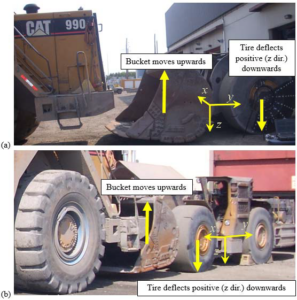
This research strives to enhance the safety of multi-piece wheel assemblies as injuries and fatalities are associated with their failure, yet information on this topic is limited.Experiments were performed to determine mechanical performance and planar deformation characteristics of several tires to aid in numerical model development. For a 29.5-29 tire, observations included determining vertical versus […]
Discover More