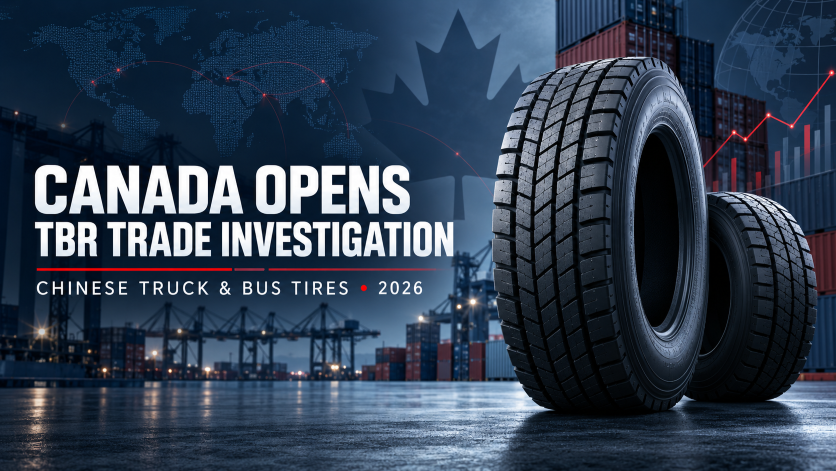
Canada has formally opened parallel investigations into whether certain truck and bus tires originating in or exported from China are being dumped and subsidized. The case could materially affect landed costs, supply strategies and market access for Chinese producers, exporters and Canadian importers.
On August 31, 2026, the Canada Border Services Agency (CBSA) initiated investigations under the Special Import Measures Act. The action followed a complaint submitted by the Canadian Retread Manufacturers Association (CRMA) and Michelin North America (Canada) Inc.
The complainants allege that increasing volumes of dumped and subsidized imports have caused price undercutting and suppression, lost sales and market share, lower capacity utilization and employment, reduced profitability, and weaker investment conditions for the Canadian industry. These are allegations at the investigation stage; no final finding of dumping, subsidization or injury has yet been made.
The product definition covers new or retreaded pneumatic rubber tires suitable for trucks, buses, trailers and other medium- and heavy-duty vehicles, with nominal rim diameters of 17.5, 19.5, 22.5 or 24.5 inches, or metric equivalents. It includes tube-type and tubeless, radial and non-radial tires, regardless of width, aspect ratio, load index, load range or ply rating, whether or not imported on wheels or rims.
| Tariff classification | General description |
|---|---|
| 4011.20.00.13 | New pneumatic tires of rubber for buses or trucks |
| 4011.20.00.19 | Other covered new truck and bus tire entries |
| 4012.12.00.00 | Retreaded tires of a kind used on buses or trucks |
Classification numbers are provided for reference. They may include non-subject goods, while subject goods may also enter under additional classifications. Product specifications and origin remain decisive.
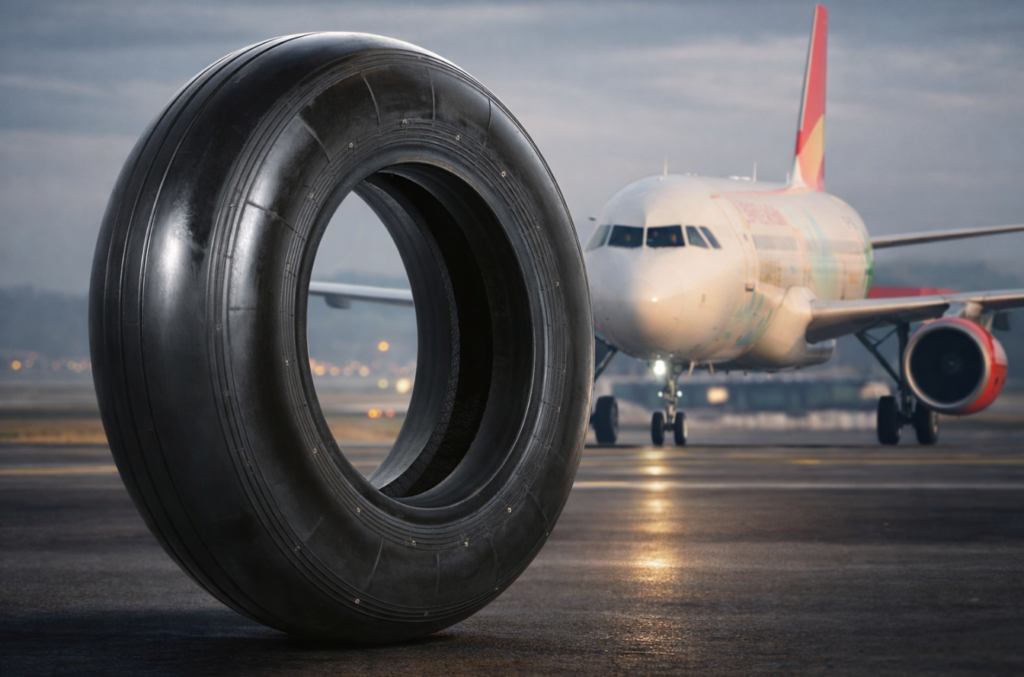
Canada’s anti-dumping and countervailing duty investigations into truck and bus tires originating in or exported from China.
The case targets the core commercial rim sizes used across regional haul, long-haul, trailer, bus and mixed-service fleets. If provisional or final duties are imposed, the immediate effect could be a sharp increase in the landed cost of covered China-origin tires in Canada. Importers may respond by accelerating near-term purchasing, reducing exposure to China-origin supply, renegotiating quotations, or seeking alternative manufacturing origins.
The investigation may also strengthen pricing support for Canadian production and non-subject imports. At the same time, tighter compliance requirements and uncertainty over future duty liability could make inventory decisions more conservative and shorten quote-validity periods.
| Party | Immediate priorities |
|---|---|
| Chinese producers and exporters | Confirm whether products fall within scope; preserve complete cost, sales and subsidy records; align data across related companies; respond fully and on time to official requests. |
| Canadian importers | Audit open orders and arrival dates; verify origin and specifications; model potential provisional-duty exposure; review contracts for duty, price-adjustment and cancellation provisions. |
| Distributors and fleet buyers | Check quote validity and inventory coverage; compare alternative origins; avoid assuming that current pricing will remain available after the preliminary decision. |
Key takeaway: the initiation does not itself impose duties, but November 30 is the principal provisional-duty risk date currently identified by CBSA. Commercial decisions made before then should account for product scope, customs entry timing and contractual responsibility for any additional duties.
TNR International will continue monitoring the investigation, including the CBSA Statement of Reasons, the CITT preliminary injury decision and any provisional measures affecting truck and bus tire trade.